
Will this tortoiseshell still look amber on the face?
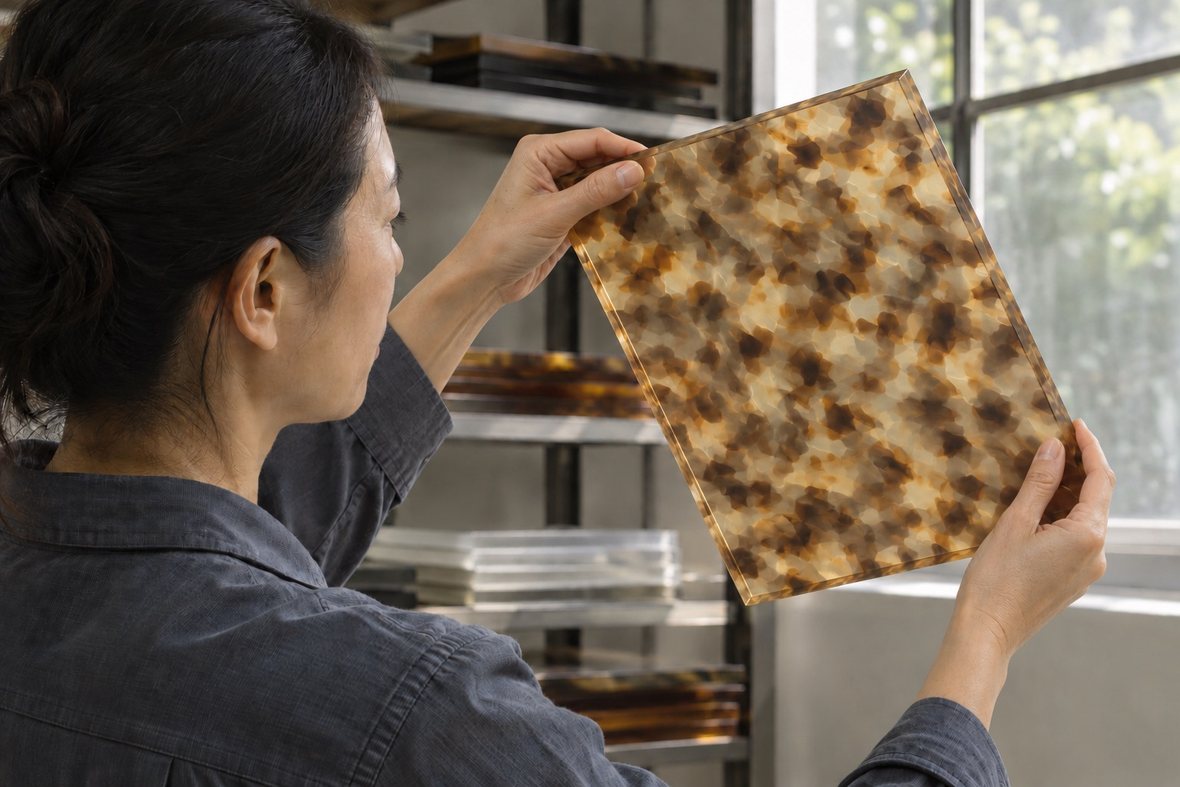
Hold a tortoiseshell acetate sheet up to a window and its amber patches can look quite vivid. Cut a narrow rim from the same pattern, fit a dark lens and put the frame on. How much amber can you still see? For a first sample, review the sheet, the cut front and the frame on the face before you approve the colour.
Start with a frame-sized window in a sheet of paper
Trace the front at actual size on opaque paper and cut away the shape of the rim. Fix the remaining pieces to clear film so the lens openings stay covered. Lay the mask over the acetate. Slide it across the sheet. A large amber patch might fill one corner while the opposite corner reads almost black. Decide whether that unevenness is part of the design, and photograph one placement you would accept.
Try the sample with the intended lens
Look at the sample on a plain light surface, then put it on in the same light. Use the lens tint chosen for the collection if it is available. Check the brow and the bridge from a normal conversation distance. For example, if you wanted a light bridge but it disappears next to the lens, mark that area. A request for more amber at the bridge gives the workshop a clearer direction than asking for a brighter frame.
Keep a physical colour reference
Keep the approved sample or a labelled offcut with the material code and lens tint. If several pattern placements are acceptable, keep examples that show the range. Take comparison photographs in the same light against the same background. When a later sample looks darker on screen, start by putting the two physical pieces side by side.